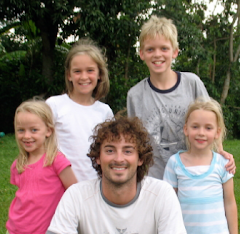
So I've been in Dar es Salaam at a number of meetings with our national team here and haven't had time to blog but more will be going up soon when I'm back in lively Kilwa :)
In the meantime, our fellowship program made the Wall Street Journal (article) and I got a shout out!
Thursday, September 24, 2009

Wednesday, September 16, 2009
Wedding Band
After that last heavy post, I thought I'd add a fun video from the last time we were in Dar. We saw this a couple times before we learned why a band would be riding around in a pickup truck playing music. It's common for processions of cars traveling from one part of the wedding to another (like ceremony to reception) to be lead by the band to let the celebration begin.
The coolest part is that as the band passed anyone on the street, people would just start dancing and joining in on the fun.
The coolest part is that as the band passed anyone on the street, people would just start dancing and joining in on the fun.
Monday, September 14, 2009
Thursday, September 10, 2009
A Control Freak in Africa
Over the last two days my Global Health Corps partner Goodluck Minja and I conducted interviews with 13 health workers in 5 different facilities throughout the Kilwa region. The facilities ranged from the regional hospital (largest facility) responsible for about 1 million people with a staff of around 40, to a health dispensary (smallest facility) responsible for a few thousand with a staff of 2.
We collected a wealth of data along the way and have continued having many epiphanies about the health information system here in Tanzania. I was also reminded of something that has been a particularly tough transition from life in the States: how incredibly dependent I am on the help of others.
For starters I don’t speak Swahili.
Of the 13 interviews, only 2 of them were in English where both Goodluck and I could contribute. The other 11 Goodluck led and drove 100% of the questioning. For the sake of a smoother conversation style, we’ve chosen to video tape each interview to review as a team later so that he doesn’t have to translate each response mid- interview. This has worked well but has left me behind the camera most of the time. We have a set list of questions that Goodluck works through though I find myself double checking with him before the end of each interview to make sure that he covered everything we had discussed. It's difficult for me to imagine how frustrating it must be for Goodluck to have me second guessing him, but he's been very patient with me.
I’m here to help but I feel like I can’t contribute to my core job, which thus far has been gathering data and interviewing people. It has been irritating at best and crippling at worst.
Perhaps the most unexpected way I lack control is in my access to information. There’s no internet and even with my personal modem, there is a lack information about virtually everything and everywhere in Africa, especially here in Kilwa. There are no phone books. There are no newspapers. There are no radio stations. There is no library. Most restaurants don’t have menus. The only signs that exist are from the one growing industry here: cell phone companies. So the only way to get information is by talking to neighbors and locals, again, something I am incapable of doing without knowing the language.
Self-reliance and independence are highly valued in American culture and particularly for me. Letting go of control, being humbled by my own inadequacy to perform basic tasks, and ultimately having to ask for help has been an incredible exercise of trust.
Luckily, that trust has been rewarded because of Goodluck. His patience for my cultural faux pas, my underdeveloped ability to learn languages, having to pay more for things when I’m around, the lack of attention he gets form others when we’re together, and just my tendency to challenge everything, is beyond inspiring. In many ways, the results of our work rest in our ability to form a trusting relationship that allows each of us to perform our best. At this point, not only can I rely on Goodluck, but I'm also confident that he will lead us to accomplish our goals.
I had no control over the partner I was paired with for this fellowship year. Thank God for Good Luck :)

Thursday, September 3, 2009
A Day in the Life
Here was the schedule of my day yesterday. I wanted to share how inefficient life is here.
Thanks to Curt for the suggestion of bringing a book with me where ever I go in Africa. I'm going to get a lot of reading done here. Anyone have suggestions for books?
- 6:30am - Left house
- 6:30am - 6:45am - walked to taxi stand
- 6:45am - 7:05am - waited for a full car from the taxi to take us to Kivinje (where our hospital is)
- 7:05am - 7:30am - taxi 28km to the hospital
- 7:30am - proposed time we'd leave with hospital staff going for a visit to a health center
- 7:30am - 9:05am - wait at hospital for others to be ready to leave
- 9:05am - 9:30am - drive to the health center
- 9:30am - 10:15am - conduct interviews with health staff (only task for the day)
- 10:15am - 4:15pm - wait for driver to return and take us back to the hospital
- 4:15pm - 4:45pm - travel back to the hospital
- 4:45pm - 5:05pm - wait for taxi back to Kilwa
- 5:05pm - 5:35pm - travel back to Kilwa
- 5:35pm - 6:00pm - walk back to our house
- 6:00pm - eat
Thanks to Curt for the suggestion of bringing a book with me where ever I go in Africa. I'm going to get a lot of reading done here. Anyone have suggestions for books?
Amazing African Performers
We had a closing dinner with the Clinton-Tanzania Team after many days of meetings. This restaurant had various African performers up on stage throughout the night but this was the most unique and amazing performance of the night.
It felt odd coming into a situation where we were going to spend the year in very rural Africa working on behalf of the poor and yet here we were in an expensive hotel restaurant with other tourists being performed for.
I still enjoyed it.
It felt odd coming into a situation where we were going to spend the year in very rural Africa working on behalf of the poor and yet here we were in an expensive hotel restaurant with other tourists being performed for.
I still enjoyed it.
Media Posting
Originally when coming to Tanzania, I was excited to do video blog posts all the time but internet is extremely slow and expensive here. So I apologize for not having more videos and pictures but I promise I'll add them the next time I'm in Dar (they have a much faster connection in the main Clinton office).
PS there's one "internet cafe" in all of Kilwa and it has 2 computers. Goodluck and I went by yesterday and the internet wasn't working. And you thought the internet was a world wide revolution...
PS there's one "internet cafe" in all of Kilwa and it has 2 computers. Goodluck and I went by yesterday and the internet wasn't working. And you thought the internet was a world wide revolution...
Where to Start?
One of the things I have been most excited about for this fellowship year was the chance to come to Africa for the first time and really know the problems that exist here. I’ve been to a number of third world countries before but I’m not naive to the fact that each country, each community has a personal spin on the issues they face. Unless you are there to observe it first hand, I’d contend it’s nearly impossible to form meaningful solutions. That hasn’t stopped me from trying though : )
Before arriving to work on the Tanzanian health information system I had been researching computer based EMRs in both the first and third world. The poor, rural areas I visited in Peru and Bolivia didn’t have computers at home but at least they had internet cafes and a large part of the population I found to be computer literate. So I put together a rough plan of how I thought our system should look like and, in so doing, committed a cardinal sin of design by coming up with a solution to a problem I didn’t understand.
The reality is that 10% of Tanzanians have electricity. 1-3 % use the internet. There are virtually no computers or electronic systems in place at all. The health “Information System” they have consists of stacks upon stacks of paper forms. The hospitals and medical centers are happy to have a box of rubber gloves to work with patients to provide the most basic level of sanitation.
I wasn’t so much shocked at this harsh reality as I was reminded of how to order problem solving; problem first, solution second. What has been different with my experience here thus far, however, has been my emotional reaction to living and experiencing the problems faced by everyday people.
When I’ve volunteered in other countries, I have stayed for a relatively short time usually in hotels with what Americans would consider the very basic necessities. We’d have electricity, running water, beds, showers, clean drinking water, food, security, telephones, etc. And though I have some of that in my home, power shuts off from 6pm to 11pm every third night and water is off every other day for the entire town. My house doesn’t have running water and was burglarized earlier this year. We live on a dirt road that can flood in the rainy season and lack most foodstuffs other than what is at the daily market.
We live in one of the nicest homes in town.
For each necessity that we Americans take for granted that is missing here, life gets a little more stressful, a little harder, and a little less productive. And actually living with this has not only helped me understand the problems Tanzania and Kilwa (the district I live in) are facing. It has made me feel and experience the problems. And, most of all, it makes me angry for the people here and passionate to help.
I could speculate who’s to blame but I won’t because that’s not really the point I want to convey. I’ve felt sympathy and empathy before when volunteering. But, knowing how temporary my experiences were and that a matter or days or weeks separated me from the comforts of America allowed me to disassociate the hardships as “their” hardships, not “my” hardships or “our” hardships. This is now my life for the foreseeable future and as I’ve been seeing things as “our” hardships, I’ve felt anger for the first time. Anger at the injustice that people die every day here because some very basic things don’t exist that should be provided for them by the modern world we live in.
Where to start? Roads? Management? Education? Economy? Governance? It’s overwhelming. But I’ve concluded thus far that GHC has made a great choice in choosing health as their mission. Helping people become and stay healthy can lead to them being able to help themselves in ways they couldn't in the past.
Rich countries have been trying to help countries in poverty all over the world but I believe the most lasting changes will happen from within the country. However, if you’re worried about surviving the day/week/year because of poor health conditions, it must be hard to think about striving to change a system that renders your country without electricity or water.
I have a much better, albeit far from encompassing, understanding of the problems facing the health systems in Tanzania now. Something I couldn’t prepare myself for before arriving here. And though Goodluck and I are working on a small project in an even smaller part of the country, there are sparks of hope with the people we’ve talked to thus far.
Change has to start somewhere and we’re ready to make it happen.
Subscribe to:
Posts (Atom)