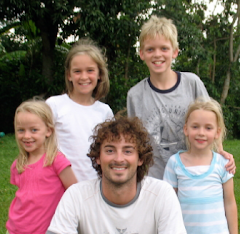
Before getting into the good things, I have some sad news from the past week. I could no longer stand the heat produced from the mop on my head. I succumbed to the pressure and shaved my head. Please do not morn my loss, however, for I will suffer less in the heat now that I have lost a significant layer of insulation. It's been 5 years since I last had short hair so I, at least, had a moment of reflection. You'll notice pictures below (some pre-cut, some post-cut).
I hope everyone back in the states is having a great holiday and Christmas time. I've been enjoying some cooler weather, some American food, and some kids play time with the Andersons in Uganda.
I was worried I had been looking forward to a break from the heat in Tanzania so much that it would be a let down but I haven't been disappointed. I've had more restful sleep and have felt more clean this past week than I have since arriving in Africa. The Andersons have a wonderful home with many of the ammenities you'd find back in The States (basically all the food products you could get back home, a projector movie set up with speakers, Christmas tree and Christmas tree lights, virtually no mosquitoes, hot showers, etc). It's been a restful haven and I'm very thankful for time off to relax and regenerate.
Our Christmas has been mostly what I'm used to from home (insert new family with 4 children though :) ). We did have a traditional Ugandan meal today with all the kids from the Rafiki village that Tyler and Kim work for (the Rafiki village is an orphanage and school that houses 100 family-less Ugandan children). But, otherwise it's been a lot of family hang out time, food, and relaxation.
I'm sad to leave tomorrow morning but excited to meet up with a number of other Global Health Corps fellows who've traveled to Zanzibar to celebrate New Years together. Zanzibar hasn't had power for over two weeks now so I'm sure I'll have more stories to tell from next week. But for now, happy holidays!
Here's me with the Andrson family after opening Christmas gifts (Tyler, Josiah, Keidi, me, Maggie, Clara, Kim).
Here I am with the kids after a great game of whiffle ball.
On Christmas day we went to visit a number of orphans in their cottages.
I rafted the Nile on Monday and had a total blast. It was by far the largest rapids I've ever been on (and they claim one of the rapids is the largest commercially rafted in the world). Our guide flipped our raft a few times in the smaller rapids just for fun. Check out the video for some clips of what I rafted through.
It's hard to believe it's almost Christmas time mainly because of how not in your face the holiday season is in Tanzania. That, and it's super hot so it just doesn't feel like the season. Either way, happy holidays to all!
I'm heading to Uganda for the Christmas week this Saturday to spend time with some long time family friends, the Andersons. I've already requested some sausage from their dutch butcher, booked a rafting trip down the Nile, and plan to get a lesson on running from Mr. Anderson (a former collegiate runner).
Though it's going to be tough not being home with my own family, I'm sure being with the Anderson family (of 6) will be a fantastic group to celebrate with.
As a little blast from the past. Here's a picture from the Anderson wedding. Can you spot me?
My dad emailed me the other day to let me know it was 16 degrees in Seattle right now. I day dreamed yesterday the next time I'll be cold.
I thought it was hot when I arrived here but that was the tail end of the Tanzanian winter. We're just now getting into the heart of the summer and it's actually getting hotter. Imagine July in Washington DC and that's what kind of weather we get here (80 degrees with 80% humidity). Now imagine there's no electricity (so no AC, not even fans), the wind dies down, there's no insulation in your house, and the bathing water is as warm as it is outside.
You know when you take a shower and start sweating right after? Try literally non stop sweating all day. As long as our power is off (as it has been the last 4 days), there's no way to cool yourself other than the ocean. I sweat every minute of the day including when I sleep.
Here's to more dreams about cold weather because I'm not getting it any time soon.
I finally have a day in our Dar es Salaam office to upload some pictures from the year. Some are random but I thought I might as well add as many as I could while I had the chance.
These are my incredible roommate (minus the little girl on the right). From left to right, Goodluck, Grace, Hilda, Me, neighbor girl.
Here's Salma our house girl/woman. Her whole family (her, husband, two daughters) all have names starting with "S". I thought only westerns did that :) She is always smiling and dancing around the house.
The A-team (Andrew, Ameet, Angie) bonding with our pumpkin (nicknamed Sir Thomas Cunningham) on Thanksgiving week.
The A-team goes diving in Kilwa the day after Thanksgiving
Out on the water with our dive instructor Valario (one of three other white people I hang out with in Kilwa).
Just finished my dive.
Riding home from work.
Do I really look like k fed with the corn rows? :(
Taking a break in the kitchen from cooking Thanksgiving dinner with Angie.
Pumpkin Pie!
Our version of Thanksgiving turkey, delicious red snapper.
Yes they make wine in Tanzania. No it's not good. We had South African wine for Thanksgiving but I got a kick out of seeing this wine.
Goodluck and I were supervising and training health staff on data collection and analysis this past Tuesday. At our second stop (we planned to visit four facilities) we picked up a 15-year-old pregnant girl who needed to be transferred to the district hospital because, being so young, she was at risk for complications during birth. Two nurses from the local facility joined us as well as the 15 year old father-to-be.
The plan was to finish our supervisions and deliver the woman to the district hospital to give birth to her coming child. I didn’t even ask how far along she was in the labor process before we got into the car because she was walking around normally, no one helping her, no urgency…
A quick aside: The short rainy season started in Tanzania around two weeks ago (the long one is typically April to June). Along with transforming the rural area from desert to lush countryside, it has transformed dusty roads to mud roads.
Soon after we left, our Land Cruiser got stuck in the mud, twice. You know if a Land Cruiser gets stuck, it’s legit mud. It took an hour to dig the car out the first time. The second time we got stuck, things got a little bit interesting.
The right half of the car slipped into an existing ditch leaving the car at a 30 degree tilt off center. After a few attempts at driving the car out of the ditch one of the nurses mentioned something to Goodluck and he motioned for me to get out of the car with him. I assumed that it was to start digging the car out again but after exiting, Goodluck told me the girl was going to deliver the baby now, in the back of the car.
Fortunately, she was in good hands with the two nurses but it was still important that we get the car out so that we could be close to a health facility when the baby arrived in case of complications. So while the nurses, father, and mother were in the back delivering a baby, Goodluck, our driver, and I were trying to dig us out of the mud.
30 minutes and multiple attempts to free the car later the car was still stuck but the baby had arrived! Can you imagine (a) giving birth in the back of a car (b) while the car was on a 30 degree tilt and (c) while it was continuously being jostled back and forth by people trying to free the car from mud?
It took us another hour to get the car out but we were finally able to deliver the new mother and baby to a facility and get them some additional medical attention. Thankfully, both baby boy and mother made it through safe and healthy.
The most striking aspect of the whole day?
I never heard the mother make a sound during the entire process. No screams, no moans, no whimpers, not even strained breathing. It was one of the most amazing displays of toughness I’ve ever seen.
This is my first Thanksgiving away from home and family in 25 years but I’m enjoying it Africa style. The two other American GHC fellows in Tanzania, Ameet and Angie, adventured down to Kilwa so that we could celebrate together. The tropical weather hasn’t put us in the Thanksgiving mood but we have managed to make pumpkin pie, mashed potatoes and we’re watching many movies today to make up for it.
There are many things I’m thankful for this Thanksgiving but, appropriately enough, I’m most thankful for my health this year.
The Global Health Corps program director came to visit Goodluck and I the other week and wrote up a cool blog post about some of the work we're doing. There's pictures! I have yet to put up many because I still don't have a fast internet connection (I've been trying to get it for close to 4 months now but I'm on Africa time so...).
It's a very long haul to get here from the states and but it was really great to have her visit and just be able to talk with an American for a few hours.
I eat/cook 95% of meals at home with my 3 roommates because it’s less expensive and because there are very few restaurants in Kilwa (and of those restaurants, they make literally the same food we can make at home so it’s not the same as going out to eat in the states). The communal mealtime provides many opportunities for conversation and has helped us all learn from and get closer to one another.
One of our favorite topics of conversation is the difference between American and Tanzanian culture. Of the many differences that exist, death has been a topic we’ve discussed at some length. Considering roughly 70% of the population of East Africa is under 27 and 45% of the population of Kilwa is under the age of 12, many Tanzanians die, by American standards, tragically young. AIDS definitely plays a role in these stats but there are many reasons people die here. From what my roommates have explained, the high rate of young death contributes to a very matter of fact culture surrounding it. I’ve had a hard time understanding and relating to this because dying in the US before you’re 70 is considered young. And the tragedy of a given death seems highly proportional to one’s age. But young death isn’t necessarily a tragedy here because it’s the norm.
After this past week, I can unfortunately understand the Tanzanian perspective a bit more.
My friend Solim died on Wednesday in one of the health centers I work in. He worked as a bartender for one of the beach hostels down the way from my house. I used to set down my things in front of where he works while I went swimming and chat with him after my workout before heading home. He's one of the few locals that spoke English and my extrovert side had been dying for people to talk to. Lucky for me, on top of actually being able to speak English, he was very warm, intelligent and thoughtful.
Last Saturday I hung out with him for close to an hour after my swim and talked about his family and growing up in Kilwa. He told me that the first time I came into the bar he knew we were going to be brothers because of how he felt around me (people use "brother" here to refer to close friends a lot). He's an artist and I wanted him to paint me some pictures so that he could earn some extra money on the side for his family of 5. We planned to meet the next day (his day off) at my house so that he could show me some sketches to chose from. However, I didn’t hear from him Sunday (which would be odd in the US but locals no showing on plans has been common for me so I didn't think twice about it).
Tuesday after my swim I went to the bar to look for him and the bartender on duty told me Solim was sick. I asked if it was serious and he said he thought he'd be back to work on Thursday. I texted Solim later that night to wish him a safe recovery and ask him if there was anything I could do to help him get better. The next morning (Wednesday) Solim sent his wife to our house to assure me he was OK and let me know he was in the health center getting treatment. Goodluck and I had a car that day for our out reach project so Goodluck called to offer Solim a ride to the district hospital to ensure the best health care. His mother-in-law picked up and said they were fine at the local health center.
Goodluck and I left for work and when we returned home, 5 hours later, our housemate told us Solim had died.
I had meetings at the health center the next morning (where Solim had died the day before) and learned that his cause of death was dehydration from vomiting and diarrhea. A simple IV would have saved his life but they didn't have saline solution at the health center, just at the hospital.
I went to his burial that day and basically the entire town of men came (he was Muslim so women don't participate in the burial process). Everyone helped carry his coffin from his father’s house to the gravesite by lining up in two long lines and passing the coffin down the row. Additionally, at the grave everyone had a chance to shovel some of the dirt on top of his body after it had been placed in the grave. The communal participation and involvement in the burial process occurred with little to no visible grief from those taking part.
It was unsettling to me because of how tragic his death seemed. On the one hand it was an incredible picture of community support and acknowledgement of a loss. But on the other hand there wasn’t the anger or sadness that might have marked a funeral in the US under the same circumstances. The people here didn’t look to blame something. Blame was irrelevant as there’s always a different reason to blame on someone’s death. There’s no age you’re supposed to make it to so the idea of dying too young or dying before your time just doesn’t seem to be a part of the discourse. Solim was dead and there was nothing anyone could do to change that. Life continues without a brother.
I'm still a little rattled by the whole thing but through personal experience I have a better picture of why the culture around death is the way it is. For me, Solim’s death has been a reminder of how life doesn’t have a proper ending time (or a scheduled one for that matter). Living life every day and loving the people around you seem that much more important.
I’ve yet to grieve like I feel like I should but I’ve been laughing a little harder at the jokes Goodluck makes at our roommate dinners each night.
One more post about inefficiencies and failed attempts at work (this is my therapy so feel free to ignore).
My work partner, Goodluck, and I been working with a group of 8 health facilities to try and help them increase the quality of the data they collect, improve their analysis of the data, and put their analysis into action to improve the health of the communities they serve.
Through our supervision of their work we’ve learned that some of the main things they are lacking are basic organizational skills (they don’t have scheduled meeting times with the rest of the staff to go over data, they lose track of where the forms are or run out of them, they don’t coordinate transporting the data together, etc). Working on this problem has seemed like an easy way we can improve the system
However, organization relies on order and dependability. (Here comes the story)
Goodluck and I have had problems in the past with others scheduling things at the last minute, miscommunication of scheduling, and general flakiness. This always results in things not getting done, things taking much more time, and losing faith or trust in those we have tried to meet with. Because of this, we’ve tried to schedule meetings well in advance and follow up with whom we’re meeting to avoid scheduling problems.
Yesterday we had scheduled to meet with a team of 7 at a local health facility to review the data they collected over October. We scheduled the meeting the last time we visited them (two weeks ago), then we called them last Friday (5 days before the meeting) to confirm, finally we even passed by the facility the morning of our meeting and spoke with our contact to again confirm our the time he had suggested for that afternoon.
2:30pm rolls around and we arrive at the health facility with presentation and meeting agenda in hand.
Our contact isn’t there but another staff member is so he calls him for us and says he’s on his way. We wait. 15 minutes later, another staff member comes and greets us and says she has one more patient and then will be happy to meet. 15 minutes later we go to meet with the staff member. She is confused why we are there so late and explains that “everyone” thought we were meeting in the morning. We explain that our contact, whom we had seen and spoken with that morning, said we were confirmed for the afternoon meeting time. She calls him. He’s still not around. Apparently, he doesn’t mention why he had confirmed that morning for our afternoon meeting. She asks if we can come the next day…
Afternoon gone.
After putting my “there’s not a problem that can’t be solved” cap on for a few hours, I concluded that there was nothing we could have done to avoid what happened.
Today (the day after the previous failed meeting) we are schedule to meet with 3 other facilities that are up to 80 miles from where we live. We scheduled our transport days in advance. We called each facility to confirm we were coming today (after scheduling with them well in advance). We scheduled with someone from the district management team to join us.
Our transport was scheduled to arrive at 8am for the long day of meetings ahead of us. We confirmed the time yesterday at 4pm. We learned at 9:30am this morning that it is now scheduled for 11:30am.
Morning gone.
It takes 1.5 hours to drive to our first meeting place and the workday tends to end very early for people here.
Afternoon gone.
Again, after putting my “there’s not a problem that can’t be solved” cap on for this one, I’m stuck with the conclusion that there’s nothing we can do to avoid this happening again.
To be honest I’m a little lost right now. How do we expect to organize anyone when we can’t be organized ourselves? All our work is dependant on meeting and coordinating and that seems to be virtually impossible. Should I get used to having whole days or even weeks wasted because of miscommunication and broken plans? Or will I be incredibly frustrated for the next 9 months?
I know there’s a happy medium to be found. I’m just not finding it right now.
All of the footage for this video was taken during our training at Stanford. That seems ages ago now though it was only about 3 months now. The folks from Seedwell did a fantastic job on this. Big thanks to them for their time and energy putting this together.
Here are Angie and Ameet, the two other American Global Health Corps fellows in Tanzania. Ameet is based on a tropical island called Zanzibar just off the coast of Dar es Salaam and Angie is a bit east of Dar in a town called Morogoro that's located at the foot of a gorgeous mountain range.
This picture was taken way back in our first week in Tanzania in August.
Here's a picture from Zanzibar I took when I was visiting Ameet for the Muslim celebration of the end of Ramadan called Eid. For those of you who don't know, Ramadan lasts about a month and Muslims don't eat during daylight hours for the entire time. As you can imagine, Eid is a huge celebration where families cook and have family and friends over for parties. The holiday lasts for 5 days but we only took part for 2. Even without the celebration, Zanzibar has by far the best food in Tanzania so far. This sunset was icing on the cake of a great weekend.
Here's a picture of the whole A-Team (Andrew, Ameet, Angie) from Tanzania. We were on the inside of an old fort in Zanzibar watching a concert of local singers and dancers as a part of the Eid celebration.
Without naming names, here's an example of an attempt to meet with a TZ official.
A local official is upset we're not meeting with him to explain our plans and ask him for permission to meet with other officials and health workers. We have tried to meet with him in the past but he doesn’t pick up our phone calls, doesn’t have voice mail (no one in TZ does), is rarely in his office, and doesn’t respond to our text messages.
We call him to apologize and request a meeting.
He miraculously picks up and is happy to hear from us but can't meet today.
Him: How about Friday? Me: OK, 10am work for you? Him: Sounds good. Me: OK, I'll call at 9:30am to confirm. (I’ve learned to do this ☺ )
Friday...
Call at 9:30am.
Him: Hello who is this? Me: It's Andrew Peterson calling from CHAI (I've explained who I am and that I'm from CHAI on no less than 5 other occasions). Him: Oh yes, hello. Me: Good morning. I was just calling to confirm this was still a good time for you. Him: What? Me: I just wanted to confirm that you’re still available for a meeting now. Him: Meeting? Me: Yes, we had scheduled a meeting this morning at 10am. I was calling to confirm that time works for you. Him: Oh… right… I’m busy right now. Can you come at 12pm? Me: OK, I’ll call to confirm at 11:30am.
Call at 11:30am.
Him: Hello who is this? Me: It's Andrew Peterson calling from CHAI (#6). I wanted to confirm this time works for you for our meeting. Him: Ahh, yes I’m actually still busy. Can you come at 2pm? Me: OK I’ll call at 1:30pm to confirm.
Call at 1:30pm.
Him: Hello who is this? Me: It's Andrew Peterson calling from CHAI (#7). I wanted to make sure you’re still available now for our meeting? Him: Umm not right now. Me: OK, we’re eager to meet and share our work plans with you. When is a good time? Would you like to call us when you’re ready to meet today? Him: OK, I’ll call you soon.
He never calls.
Currently, we’re waiting for another meeting that was scheduled initially for yesterday mid day.
At 5pm last night we were still waiting and the person we had been waiting to meet with goes home because he’s had a long day.
We scheduled to meet with him at 8am. It’s now 10:30am and we’re still waiting.
At least I have some internet connection to keep me busy.
Tanzania has a long history of polygamous relationships with tribal men’s wealth and power being connected to the number of wives and children they have.
Tribalism was abolished in 1961 when Tanzania gained independence from England.
Current Tanzanian law on polygamy changes depending on what religion you claim to be:
·It’s against the law for Christians (~45% of population) to have more than one wife.
·It’s legal for Muslims (~35% of population) to have up to 4 wives.
·If you ascribe to a tribal religion, there is no legal limit to the number of wives you can take.
Of all the cultural differences between the US and Tanzania, I have had the hardest time understanding the dynamics of sexual and romantic relationships here. Though sexism and differences in gender equality are huge issues that have been hard to face and deal with as well, because of the implications that relationships and sex have on HIV/AIDS, I’ve been particularly keen to understand that aspect of the culture.
Here’s a conversation I had with a friend a few weeks ago.
Me: So do people here go on out on dates?
Friend: Dates? What is that?
Me: Hmm, dates, you know like taking a girl to dinner or the movies?
Friend (Gives me a puzzled look): …
Me (to my work mate, Goodluck, sitting close by): Hey what is the Swahili word for date, like to take a girl on a date?
Goodluck (looking puzzled): Umm, we just call it ‘date’. There is no word for it. (friend understands now)
Me: You don’t have a word for date in Swahili? I’m assuming that doesn’t happen much then?
Friend and Goodluck: Nope
Granted, I have friends here in the younger generation that are starting to date more, but, they are typically dating Westerners so that doesn’t really count to me. When I explain to other friends the idea of going on dates and, particularly, having multiple past dating relationships, their take on it is that by dating women and not marrying them I’m tainting them.
They say, “What man would want to marry someone you’ve dated for a year?”
Ironically, I’ve read that in parts of Africa, and heard this to be true for rural Tanzania, a woman with one child is more desirable to marry than a woman with no children as she’s proven she is fertile. It’s this juxtaposition of seemingly conservative views about dating and marriage and more liberal attitudes about sex that has had me continually confused.
Men and women don’t date here. They get married. Most families don’t allow children to have boyfriends and girlfriends because they’re only allowed to have one. The process, as I understand it, of finding the right marriage partner has more to do with family and money and practicality than it does with love. Parents have the ability to veto any potential partner, husbands pay dowries to their wife’s family and husbands sometimes even take less attractive wives to reduce the chances that she cheats on him.
I know relationships differ greatly but, on the whole, husbands and wives aren’t companions. They don’t hang out or go on dates. Wives spend time with the children and husbands spend time at work or with friends. Women make babies and men finance it.
That brings me to sex.
Here’s an excerpt from Stephanie Nolan’s 28: Stories of AIDS in Africa:
AIDS in Africa is often understood as a disease of poverty – of hungry young women who sell sex for food, slum dwellers who can’t afford condoms, and subsistence farmers who can’t pay for medial treatment. And this is accurate. But that picture is not the full one: AIDS is also a disease of wealth. Population survey’s across East Africa have found that rates of HIV infection are more than three times higher for people living in the best-off households than for those in the poorest. Why? People who have a bit of disposable cash can afford to pay for the services of commercial sex workers, or maintain a girlfriend in the city as well as a wife back in the village, or have sex with an occasional partner and in return pay her school fees or buy her a cell phone.
Years of research have made clear that Africans do not, in the course of their lives, have a greater number of sexual partners than North Americans or Europeans. But where people in the West follow patterns of serial monogamy, moving from one partner to the next in relationships of varying length with limited overlap, many sub-Saharan Africans have the same number of partners in what are called concurrent sexual networks, where some or all of the partners overlap. Because of the way HIV works, those networks greatly increase the odds of infection. An estimated 40 percent of HIV transmission occurs when the people transmitting the virus are in the initial six weeks of infection-when their blood teems with the virus, before their bodies muster an immune response and push the level of HIV back down for several years. Say the civil-servant husband gets HIV from his girlfriend in the city. A few weeks later, as the presence of the virus peaks in his system, he goes home and has sex with his wife. She gets infected. Then when her husband goes back to the city, and while she has the peak level of virus in her system, she has sex with her local boyfriend-who is then at much higher risk of infection. And so are the boyfriend’s other partners.
This explanation has helped me understand the higher risk that culturally common sexual practices here mean for AIDS transmission. But, what Mrs. Nolen’s book didn’t explain is how common a practice taking concurrent sexual relationships actually is.
Again, though there are exceptions, if you have the money and you’re a man, you pay for sex or you pay for things for a girlfriend in exchange for a sexual relationship. If you’re a woman and you want extra money or want some financial independence from your husband, you get paid for sex or get an extra boyfriend to pay for things you want.
Here’s how another conversation went with a friend while a group of us we were at a bar:
Friend (looking around the bar): So who do you want?
Me: Like women? Uhh, I’m good just hanging out with the group.
Friend (looks a little incredulous): You mean you don’t want to have sex with someone tonight?
Me (while thinking through the many reasons I didn’t want that including not wanting to risk contracting AIDS): No, I’m good. You got your eye on one?
Friend (ignoring my efforts to change the subject and even more incredulous): You know you could have anyone of them, right?
Me: Wait, they’re all prostitutes?
Friend: Not exactly, but if you bought a girl and her friends their drinks all night you could definitely have sex with her.
Me (puzzled): So which ones are the prostitutes and which ones are not?
Friend: Umm, I don’t know.
Me: That could get dicey. So what’s the going rate for a prostitute?
Me (silently dumbfounded thinking that was the price of our taxi to the bar tonight): …interesting… no, I’m good.
Friend (mutters something about me being homosexual, collects himself and gives me a polite): OK.
This is just an example of one conversation but I’ve had many like it. From my experiences, exchanges of sex for money are inexpensive and, consequently, pervasive regardless of your relationships status, rate of AIDS prevalence, or age. The major factor is money. And because I have it, people expect me to pay for sex.
There are many more intricacies to the romantic and sexual relationships of Tanzanians that I’ve learned and have yet to learn. I’ve been trying hard to be honestly inquisitive and not judgmental because, at the end of the day, it’s just different than what I’m used to, not better or worse. We [Westerners] undoubtedly have our own ironies and downsides to our romantic/sexual relationship institutions.
Unfortunately for East Africa, the consequences of the current cultural practices are devastatingly high rates of HIV/AIDS transmission.
Recent statistics estimate 23 million people in sub-Saharan Africa are infected with HIV. In late 2007 only 2 million people from that group were taking antiretrovirals.
Goodluck and I arrived back in Kilwa recently after a planning period in Dar with our management team to map out our work plan for the following year. Having a detailed Excel sheet with our strategy relaxed my type-A tendencies a bit as I started being able to visualize the road we have ahead of us.
Hitting the water for an otherwise boring morning swim, I started processing our main next steps. “We have to speak with doctors in each health field to prioritize the data we are collecting. We have to speak with the dentist at the district hospital to see if we can get a complete map of the health facilities in Kilwa. We have to speak to contacts at the health facilities we’re working with this month to plan when to consolidate their data from the previous month. We have to speak…” Get the pattern yet?
I keep assuming there has to be other less formal, less time-consuming ways to get information here, especially for professional organizations and critical health/hospital information. But then I think again and realize that’s exactly why I’m here in the first place (to work on health information systems). I need to remember to shake the Internet age off me every morning before tackling our work, but it’s hard to do.
Information in Tanzania exists in people and is disseminated orally. It is 500 years after the advent of the printing press yet, particularly for rural Tanzania, it’s like that never reached its way down here. Information is locally based and it is shaped by each human who passes it on. The details and accuracy are then the product of the person who owns the information and are virtually impossible to objectively validate or verify outside the community of people one knows.
I’ve been reading Stephanie Nolen’s 28: Stories of AIDS in Africa. In story number one, Siphiwe Hlophe remembers when doctors informed her that her sister was infected with AIDS. Stephanie writes, “Siphiwe kept the information from her sister. She was afraid to touch her, wondering if the rumors were true if she could catch the disease by bathing or feeding her. Three days after the test her sister died. ‘If only I’d had information about HIV, maybe she’d be alive.’ Siphiwe said. But it would be years before she learned any more. ‘The page of HIV was closed to me until I discovered my own status.’ But even then, five years later, people didn’t know any better.”
And how could they know any better? Who were they going to ask? Who even wanted to ask?
At least for our project, Goodluck and I know who we need to talk to and trust that they’ll have the information we’re looking for. Even if we don’t completely trust them, for really important data we know we can verify it with specialists or even via the Internet. Our biggest challenge is time, not quality information or the means to get it.
During one of our visits to a rural health center, Goodluck was approached by a man desperately seeking information and advice on an apparent STI (sexually transmitted infection). He couldn’t physically walk to the hospital that was 20 miles away and couldn’t afford treatment even if he made it. That, and the treatment he would get would likely be from, at best, a nurse with limited training (especially for non critical illnesses). I couldn’t understand what the man was talking to Goodluck about but I could tell it was more than just asking for money. He was terrified.
I came to Global Health Corps and the Clinton Foundation from Google; the virtual epicenter for all information. Many (including myself) have seen the internet as the ultimate liberator of information to the world. However, considering again that western society has had many important technological advances and the oral tradition continues to remain so strong here, it’s unlikely that technology alone (Google or otherwise) will ever solve the information problems facing the East Africa.
Solutions aside, when I think about what it would be like to need information and not know how to get it, I feel terrified too. And though it’s hard to foresee being in a real situation where I don’t know how to get accurate data, I more clearly see the value of working on health information systems in a place where non-existent, poor quality, or false data seem common.
So I've been in Dar es Salaam at a number of meetings with our national team here and haven't had time to blog but more will be going up soon when I'm back in lively Kilwa :)
In the meantime, our fellowship program made the Wall Street Journal (article) and I got a shout out!
After that last heavy post, I thought I'd add a fun video from the last time we were in Dar. We saw this a couple times before we learned why a band would be riding around in a pickup truck playing music. It's common for processions of cars traveling from one part of the wedding to another (like ceremony to reception) to be lead by the band to let the celebration begin.
The coolest part is that as the band passed anyone on the street, people would just start dancing and joining in on the fun.
Over the last two days my Global Health Corps partner Goodluck Minja and I conducted interviews with 13 health workers in 5 different facilities throughout the Kilwa region. The facilities ranged from the regional hospital (largest facility) responsible for about 1 million people with a staff of around 40, to a health dispensary (smallest facility) responsible for a few thousand with a staff of 2.
We collected a wealth of data along the way and have continued having many epiphanies about the health information system here in Tanzania. I was also reminded of something that has been a particularly tough transition from life in the States: how incredibly dependent I am on the help of others.
For starters I don’t speak Swahili.
Of the 13 interviews, only 2 of them were in English where both Goodluck and I could contribute. The other 11 Goodluck led and drove 100% of the questioning. For the sake of a smoother conversation style, we’ve chosen to video tape each interview to review as a team later so that he doesn’t have to translate each response mid- interview. This has worked well but has left me behind the camera most of the time. We have a set list of questions that Goodluck works through though I find myself double checking with him before the end of each interview to make sure that he covered everything we had discussed. It's difficult for me to imagine how frustrating it must be for Goodluck to have me second guessing him, but he's been very patient with me.
I’m here to help but I feel like I can’t contribute to my core job, which thus far has been gathering data and interviewing people. It has been irritating at best and crippling at worst.
Perhaps the most unexpected way I lack control is in my access to information. There’s no internet and even with my personal modem, there is a lack information about virtually everything and everywhere in Africa, especially here in Kilwa. There are no phone books. There are no newspapers. There are no radio stations. There is no library. Most restaurants don’t have menus. The only signs that exist are from the one growing industry here: cell phone companies. So the only way to get information is by talking to neighbors and locals, again, something I am incapable of doing without knowing the language.
Self-reliance and independence are highly valued in American culture and particularly for me. Letting go of control, being humbled by my own inadequacy to perform basic tasks, and ultimately having to ask for help has been an incredible exercise of trust.
Luckily, that trust has been rewarded because of Goodluck. His patience for my cultural faux pas, my underdeveloped ability to learn languages, having to pay more for things when I’m around, the lack of attention he gets form others when we’re together, and just my tendency to challenge everything, is beyond inspiring. In many ways, the results of our work rest in our ability to form a trusting relationship that allows each of us to perform our best. At this point, not only can I rely on Goodluck, but I'm also confident that he will lead us to accomplish our goals.
I had no control over the partner I was paired with for this fellowship year. Thank God for Good Luck :)
Here was the schedule of my day yesterday. I wanted to share how inefficient life is here.
6:30am - Left house
6:30am - 6:45am - walked to taxi stand
6:45am - 7:05am - waited for a full car from the taxi to take us to Kivinje (where our hospital is)
7:05am - 7:30am - taxi 28km to the hospital
7:30am - proposed time we'd leave with hospital staff going for a visit to a health center
7:30am - 9:05am - wait at hospital for others to be ready to leave
9:05am - 9:30am - drive to the health center
9:30am - 10:15am - conduct interviews with health staff (only task for the day)
10:15am - 4:15pm - wait for driver to return and take us back to the hospital
4:15pm - 4:45pm - travel back to the hospital
4:45pm - 5:05pm - wait for taxi back to Kilwa
5:05pm - 5:35pm - travel back to Kilwa
5:35pm - 6:00pm - walk back to our house
6:00pm - eat
Additionally, the Muslim world, which is a high percentage of the coastal population in Tanzania, is celebrating Ramadan now and don't eat food while the sun is up. And more importantly for Goodluck and me, they don't make food in any restaurants. We thought we'd be home by lunch time (according to the hospital staff) so planned on eating our first meal then. Reality was, we joined in the fast :)
Thanks to Curt for the suggestion of bringing a book with me where ever I go in Africa. I'm going to get a lot of reading done here. Anyone have suggestions for books?
We had a closing dinner with the Clinton-Tanzania Team after many days of meetings. This restaurant had various African performers up on stage throughout the night but this was the most unique and amazing performance of the night.
It felt odd coming into a situation where we were going to spend the year in very rural Africa working on behalf of the poor and yet here we were in an expensive hotel restaurant with other tourists being performed for.
Originally when coming to Tanzania, I was excited to do video blog posts all the time but internet is extremely slow and expensive here. So I apologize for not having more videos and pictures but I promise I'll add them the next time I'm in Dar (they have a much faster connection in the main Clinton office).
PS there's one "internet cafe" in all of Kilwa and it has 2 computers. Goodluck and I went by yesterday and the internet wasn't working. And you thought the internet was a world wide revolution...
One of the things I have been most excited about for this fellowship year was the chance to come to Africa for the first time and really know the problems that exist here. I’ve been to a number of third world countries before but I’m not naive to the fact that each country, each community has a personal spin on the issues they face. Unless you are there to observe it first hand, I’d contend it’s nearly impossible to form meaningful solutions. That hasn’t stopped me from trying though : )
Before arriving to work on the Tanzanian health information system I had been researching computer based EMRs in both the first and third world. The poor, rural areas I visited in Peru and Bolivia didn’t have computers at home but at least they had internet cafes and a large part of the population I found to be computer literate. So I put together a rough plan of how I thought our system should look like and, in so doing, committed a cardinal sin of design by coming up with a solution to a problem I didn’t understand.
The reality is that 10% of Tanzanians have electricity. 1-3 % use the internet. There are virtually no computers or electronic systems in place at all. The health “Information System” they have consists of stacks upon stacks of paper forms. The hospitals and medical centers are happy to have a box of rubber gloves to work with patients to provide the most basic level of sanitation.
I wasn’t so much shocked at this harsh reality as I was reminded of how to order problem solving; problem first, solution second. What has been different with my experience here thus far, however, has been my emotional reaction to living and experiencing the problems faced by everyday people.
When I’ve volunteered in other countries, I have stayed for a relatively short time usually in hotels with what Americans would consider the very basic necessities. We’d have electricity, running water, beds, showers, clean drinking water, food, security, telephones, etc. And though I have some of that in my home, power shuts off from 6pm to 11pm every third night and water is off every other day for the entire town. My house doesn’t have running water and was burglarized earlier this year. We live on a dirt road that can flood in the rainy season and lack most foodstuffs other than what is at the daily market.
We live in one of the nicest homes in town.
For each necessity that we Americans take for granted that is missing here, life gets a little more stressful, a little harder, and a little less productive. And actually living with this has not only helped me understand the problems Tanzania and Kilwa (the district I live in) are facing. It has made me feel and experience the problems. And, most of all, it makes me angry for the people here and passionate to help.
I could speculate who’s to blame but I won’t because that’s not really the point I want to convey. I’ve felt sympathy and empathy before when volunteering. But, knowing how temporary my experiences were and that a matter or days or weeks separated me from the comforts of America allowed me to disassociate the hardships as “their” hardships, not “my” hardships or “our” hardships. This is now my life for the foreseeable future and as I’ve been seeing things as “our” hardships, I’ve felt anger for the first time. Anger at the injustice that people die every day here because some very basic things don’t exist that should be provided for them by the modern world we live in.
Where to start? Roads? Management? Education? Economy? Governance? It’s overwhelming. But I’ve concluded thus far that GHC has made a great choice in choosing health as their mission. Helping people become and stay healthy can lead to them being able to help themselves in ways they couldn't in the past.
Rich countries have been trying to help countries in poverty all over the world but I believe the most lasting changes will happen from within the country. However, if you’re worried about surviving the day/week/year because of poor health conditions, it must be hard to think about striving to change a system that renders your country without electricity or water.
I have a much better, albeit far from encompassing, understanding of the problems facing the health systems in Tanzania now. Something I couldn’t prepare myself for before arriving here. And though Goodluck and I are working on a small project in an even smaller part of the country, there are sparks of hope with the people we’ve talked to thus far.
Change has to start somewhere and we’re ready to make it happen.
I'm living and working in Tanzania all year on a project with the Clinton Foundation and Global Health Corps. I'm trying to write all of my "Ah ha" moments down to share with the rest of you.