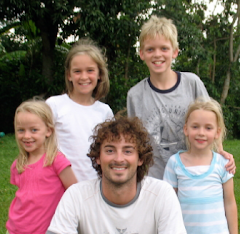
This is my first Thanksgiving away from home and family in 25 years but I’m enjoying it Africa style. The two other American GHC fellows in Tanzania, Ameet and Angie, adventured down to Kilwa so that we could celebrate together. The tropical weather hasn’t put us in the Thanksgiving mood but we have managed to make pumpkin pie, mashed potatoes and we’re watching many movies today to make up for it.
There are many things I’m thankful for this Thanksgiving but, appropriately enough, I’m most thankful for my health this year.
I love and miss all of my family and friends.
HAPPY THANKSGIVING!
Thursday, November 26, 2009

Thursday, November 19, 2009
GHC Post
The Global Health Corps program director came to visit Goodluck and I the other week and wrote up a cool blog post about some of the work we're doing. There's pictures! I have yet to put up many because I still don't have a fast internet connection (I've been trying to get it for close to 4 months now but I'm on Africa time so...).
It's a very long haul to get here from the states and but it was really great to have her visit and just be able to talk with an American for a few hours.
It's a very long haul to get here from the states and but it was really great to have her visit and just be able to talk with an American for a few hours.
Thursday, November 12, 2009
Health Care Hits Home
I eat/cook 95% of meals at home with my 3 roommates because it’s less expensive and because there are very few restaurants in Kilwa (and of those restaurants, they make literally the same food we can make at home so it’s not the same as going out to eat in the states). The communal mealtime provides many opportunities for conversation and has helped us all learn from and get closer to one another.
One of our favorite topics of conversation is the difference between American and Tanzanian culture. Of the many differences that exist, death has been a topic we’ve discussed at some length. Considering roughly 70% of the population of East Africa is under 27 and 45% of the population of Kilwa is under the age of 12, many Tanzanians die, by American standards, tragically young. AIDS definitely plays a role in these stats but there are many reasons people die here. From what my roommates have explained, the high rate of young death contributes to a very matter of fact culture surrounding it. I’ve had a hard time understanding and relating to this because dying in the US before you’re 70 is considered young. And the tragedy of a given death seems highly proportional to one’s age. But young death isn’t necessarily a tragedy here because it’s the norm.
After this past week, I can unfortunately understand the Tanzanian perspective a bit more.
My friend Solim died on Wednesday in one of the health centers I work in. He worked as a bartender for one of the beach hostels down the way from my house. I used to set down my things in front of where he works while I went swimming and chat with him after my workout before heading home. He's one of the few locals that spoke English and my extrovert side had been dying for people to talk to. Lucky for me, on top of actually being able to speak English, he was very warm, intelligent and thoughtful.
Last Saturday I hung out with him for close to an hour after my swim and talked about his family and growing up in Kilwa. He told me that the first time I came into the bar he knew we were going to be brothers because of how he felt around me (people use "brother" here to refer to close friends a lot). He's an artist and I wanted him to paint me some pictures so that he could earn some extra money on the side for his family of 5. We planned to meet the next day (his day off) at my house so that he could show me some sketches to chose from. However, I didn’t hear from him Sunday (which would be odd in the US but locals no showing on plans has been common for me so I didn't think twice about it).
Tuesday after my swim I went to the bar to look for him and the bartender on duty told me Solim was sick. I asked if it was serious and he said he thought he'd be back to work on Thursday. I texted Solim later that night to wish him a safe recovery and ask him if there was anything I could do to help him get better. The next morning (Wednesday) Solim sent his wife to our house to assure me he was OK and let me know he was in the health center getting treatment. Goodluck and I had a car that day for our out reach project so Goodluck called to offer Solim a ride to the district hospital to ensure the best health care. His mother-in-law picked up and said they were fine at the local health center.
Goodluck and I left for work and when we returned home, 5 hours later, our housemate told us Solim had died.
I had meetings at the health center the next morning (where Solim had died the day before) and learned that his cause of death was dehydration from vomiting and diarrhea. A simple IV would have saved his life but they didn't have saline solution at the health center, just at the hospital.
I went to his burial that day and basically the entire town of men came (he was Muslim so women don't participate in the burial process). Everyone helped carry his coffin from his father’s house to the gravesite by lining up in two long lines and passing the coffin down the row. Additionally, at the grave everyone had a chance to shovel some of the dirt on top of his body after it had been placed in the grave. The communal participation and involvement in the burial process occurred with little to no visible grief from those taking part.
It was unsettling to me because of how tragic his death seemed. On the one hand it was an incredible picture of community support and acknowledgement of a loss. But on the other hand there wasn’t the anger or sadness that might have marked a funeral in the US under the same circumstances. The people here didn’t look to blame something. Blame was irrelevant as there’s always a different reason to blame on someone’s death. There’s no age you’re supposed to make it to so the idea of dying too young or dying before your time just doesn’t seem to be a part of the discourse. Solim was dead and there was nothing anyone could do to change that. Life continues without a brother.
I'm still a little rattled by the whole thing but through personal experience I have a better picture of why the culture around death is the way it is. For me, Solim’s death has been a reminder of how life doesn’t have a proper ending time (or a scheduled one for that matter). Living life every day and loving the people around you seem that much more important.
I’ve yet to grieve like I feel like I should but I’ve been laughing a little harder at the jokes Goodluck makes at our roommate dinners each night.
One of our favorite topics of conversation is the difference between American and Tanzanian culture. Of the many differences that exist, death has been a topic we’ve discussed at some length. Considering roughly 70% of the population of East Africa is under 27 and 45% of the population of Kilwa is under the age of 12, many Tanzanians die, by American standards, tragically young. AIDS definitely plays a role in these stats but there are many reasons people die here. From what my roommates have explained, the high rate of young death contributes to a very matter of fact culture surrounding it. I’ve had a hard time understanding and relating to this because dying in the US before you’re 70 is considered young. And the tragedy of a given death seems highly proportional to one’s age. But young death isn’t necessarily a tragedy here because it’s the norm.
After this past week, I can unfortunately understand the Tanzanian perspective a bit more.
My friend Solim died on Wednesday in one of the health centers I work in. He worked as a bartender for one of the beach hostels down the way from my house. I used to set down my things in front of where he works while I went swimming and chat with him after my workout before heading home. He's one of the few locals that spoke English and my extrovert side had been dying for people to talk to. Lucky for me, on top of actually being able to speak English, he was very warm, intelligent and thoughtful.
Last Saturday I hung out with him for close to an hour after my swim and talked about his family and growing up in Kilwa. He told me that the first time I came into the bar he knew we were going to be brothers because of how he felt around me (people use "brother" here to refer to close friends a lot). He's an artist and I wanted him to paint me some pictures so that he could earn some extra money on the side for his family of 5. We planned to meet the next day (his day off) at my house so that he could show me some sketches to chose from. However, I didn’t hear from him Sunday (which would be odd in the US but locals no showing on plans has been common for me so I didn't think twice about it).
Tuesday after my swim I went to the bar to look for him and the bartender on duty told me Solim was sick. I asked if it was serious and he said he thought he'd be back to work on Thursday. I texted Solim later that night to wish him a safe recovery and ask him if there was anything I could do to help him get better. The next morning (Wednesday) Solim sent his wife to our house to assure me he was OK and let me know he was in the health center getting treatment. Goodluck and I had a car that day for our out reach project so Goodluck called to offer Solim a ride to the district hospital to ensure the best health care. His mother-in-law picked up and said they were fine at the local health center.
Goodluck and I left for work and when we returned home, 5 hours later, our housemate told us Solim had died.
I had meetings at the health center the next morning (where Solim had died the day before) and learned that his cause of death was dehydration from vomiting and diarrhea. A simple IV would have saved his life but they didn't have saline solution at the health center, just at the hospital.
I went to his burial that day and basically the entire town of men came (he was Muslim so women don't participate in the burial process). Everyone helped carry his coffin from his father’s house to the gravesite by lining up in two long lines and passing the coffin down the row. Additionally, at the grave everyone had a chance to shovel some of the dirt on top of his body after it had been placed in the grave. The communal participation and involvement in the burial process occurred with little to no visible grief from those taking part.
It was unsettling to me because of how tragic his death seemed. On the one hand it was an incredible picture of community support and acknowledgement of a loss. But on the other hand there wasn’t the anger or sadness that might have marked a funeral in the US under the same circumstances. The people here didn’t look to blame something. Blame was irrelevant as there’s always a different reason to blame on someone’s death. There’s no age you’re supposed to make it to so the idea of dying too young or dying before your time just doesn’t seem to be a part of the discourse. Solim was dead and there was nothing anyone could do to change that. Life continues without a brother.
I'm still a little rattled by the whole thing but through personal experience I have a better picture of why the culture around death is the way it is. For me, Solim’s death has been a reminder of how life doesn’t have a proper ending time (or a scheduled one for that matter). Living life every day and loving the people around you seem that much more important.
I’ve yet to grieve like I feel like I should but I’ve been laughing a little harder at the jokes Goodluck makes at our roommate dinners each night.
Wednesday, November 4, 2009
Facial Hair Update
I shaved my beard the other day (but not my head yet). So instead of people calling me Jesus everywhere I go, they're now calling me Sampson.
My head hair is also long enough that I had it braided but I looked too feminine so I took it out.
My head hair is also long enough that I had it braided but I looked too feminine so I took it out.
I Can’t Force It!
One more post about inefficiencies and failed attempts at work (this is my therapy so feel free to ignore).
My work partner, Goodluck, and I been working with a group of 8 health facilities to try and help them increase the quality of the data they collect, improve their analysis of the data, and put their analysis into action to improve the health of the communities they serve.
Through our supervision of their work we’ve learned that some of the main things they are lacking are basic organizational skills (they don’t have scheduled meeting times with the rest of the staff to go over data, they lose track of where the forms are or run out of them, they don’t coordinate transporting the data together, etc). Working on this problem has seemed like an easy way we can improve the system
However, organization relies on order and dependability. (Here comes the story)
Goodluck and I have had problems in the past with others scheduling things at the last minute, miscommunication of scheduling, and general flakiness. This always results in things not getting done, things taking much more time, and losing faith or trust in those we have tried to meet with. Because of this, we’ve tried to schedule meetings well in advance and follow up with whom we’re meeting to avoid scheduling problems.
Yesterday we had scheduled to meet with a team of 7 at a local health facility to review the data they collected over October. We scheduled the meeting the last time we visited them (two weeks ago), then we called them last Friday (5 days before the meeting) to confirm, finally we even passed by the facility the morning of our meeting and spoke with our contact to again confirm our the time he had suggested for that afternoon.
2:30pm rolls around and we arrive at the health facility with presentation and meeting agenda in hand.
Our contact isn’t there but another staff member is so he calls him for us and says he’s on his way. We wait. 15 minutes later, another staff member comes and greets us and says she has one more patient and then will be happy to meet. 15 minutes later we go to meet with the staff member. She is confused why we are there so late and explains that “everyone” thought we were meeting in the morning. We explain that our contact, whom we had seen and spoken with that morning, said we were confirmed for the afternoon meeting time. She calls him. He’s still not around. Apparently, he doesn’t mention why he had confirmed that morning for our afternoon meeting. She asks if we can come the next day…
Afternoon gone.
After putting my “there’s not a problem that can’t be solved” cap on for a few hours, I concluded that there was nothing we could have done to avoid what happened.
Today (the day after the previous failed meeting) we are schedule to meet with 3 other facilities that are up to 80 miles from where we live. We scheduled our transport days in advance. We called each facility to confirm we were coming today (after scheduling with them well in advance). We scheduled with someone from the district management team to join us.
Our transport was scheduled to arrive at 8am for the long day of meetings ahead of us. We confirmed the time yesterday at 4pm. We learned at 9:30am this morning that it is now scheduled for 11:30am.
Morning gone.
It takes 1.5 hours to drive to our first meeting place and the workday tends to end very early for people here.
Afternoon gone.
Again, after putting my “there’s not a problem that can’t be solved” cap on for this one, I’m stuck with the conclusion that there’s nothing we can do to avoid this happening again.
To be honest I’m a little lost right now. How do we expect to organize anyone when we can’t be organized ourselves? All our work is dependant on meeting and coordinating and that seems to be virtually impossible. Should I get used to having whole days or even weeks wasted because of miscommunication and broken plans? Or will I be incredibly frustrated for the next 9 months?
I know there’s a happy medium to be found. I’m just not finding it right now.
My work partner, Goodluck, and I been working with a group of 8 health facilities to try and help them increase the quality of the data they collect, improve their analysis of the data, and put their analysis into action to improve the health of the communities they serve.
Through our supervision of their work we’ve learned that some of the main things they are lacking are basic organizational skills (they don’t have scheduled meeting times with the rest of the staff to go over data, they lose track of where the forms are or run out of them, they don’t coordinate transporting the data together, etc). Working on this problem has seemed like an easy way we can improve the system
However, organization relies on order and dependability. (Here comes the story)
Goodluck and I have had problems in the past with others scheduling things at the last minute, miscommunication of scheduling, and general flakiness. This always results in things not getting done, things taking much more time, and losing faith or trust in those we have tried to meet with. Because of this, we’ve tried to schedule meetings well in advance and follow up with whom we’re meeting to avoid scheduling problems.
Yesterday we had scheduled to meet with a team of 7 at a local health facility to review the data they collected over October. We scheduled the meeting the last time we visited them (two weeks ago), then we called them last Friday (5 days before the meeting) to confirm, finally we even passed by the facility the morning of our meeting and spoke with our contact to again confirm our the time he had suggested for that afternoon.
2:30pm rolls around and we arrive at the health facility with presentation and meeting agenda in hand.
Our contact isn’t there but another staff member is so he calls him for us and says he’s on his way. We wait. 15 minutes later, another staff member comes and greets us and says she has one more patient and then will be happy to meet. 15 minutes later we go to meet with the staff member. She is confused why we are there so late and explains that “everyone” thought we were meeting in the morning. We explain that our contact, whom we had seen and spoken with that morning, said we were confirmed for the afternoon meeting time. She calls him. He’s still not around. Apparently, he doesn’t mention why he had confirmed that morning for our afternoon meeting. She asks if we can come the next day…
Afternoon gone.
After putting my “there’s not a problem that can’t be solved” cap on for a few hours, I concluded that there was nothing we could have done to avoid what happened.
Today (the day after the previous failed meeting) we are schedule to meet with 3 other facilities that are up to 80 miles from where we live. We scheduled our transport days in advance. We called each facility to confirm we were coming today (after scheduling with them well in advance). We scheduled with someone from the district management team to join us.
Our transport was scheduled to arrive at 8am for the long day of meetings ahead of us. We confirmed the time yesterday at 4pm. We learned at 9:30am this morning that it is now scheduled for 11:30am.
Morning gone.
It takes 1.5 hours to drive to our first meeting place and the workday tends to end very early for people here.
Afternoon gone.
Again, after putting my “there’s not a problem that can’t be solved” cap on for this one, I’m stuck with the conclusion that there’s nothing we can do to avoid this happening again.
To be honest I’m a little lost right now. How do we expect to organize anyone when we can’t be organized ourselves? All our work is dependant on meeting and coordinating and that seems to be virtually impossible. Should I get used to having whole days or even weeks wasted because of miscommunication and broken plans? Or will I be incredibly frustrated for the next 9 months?
I know there’s a happy medium to be found. I’m just not finding it right now.
Tuesday, October 27, 2009
GHC Video
All of the footage for this video was taken during our training at Stanford. That seems ages ago now though it was only about 3 months now. The folks from Seedwell did a fantastic job on this. Big thanks to them for their time and energy putting this together.
The Global Health Corps from Seedwell on Vimeo.
Subscribe to:
Posts (Atom)