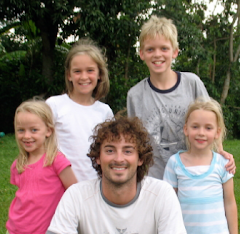
After going 7 months without seeing anyone from home, my family came to visit for two weeks and I had a great trip with them! I'll be putting up a series of videos this week shot during our Safari through norther Tanzania and southern Kenya. Enjoy!
Here's the first:
Monday, March 1, 2010

Wednesday, February 17, 2010
Sunday, February 14, 2010
Thursday, February 11, 2010
Redesigning "the meeting"
At my last job in the US we desperately tried everything we could to avoid having meetings. We tried a "no meeting day" or tried to establish a rating system to get rid of meetings that received low scores.
In contrast, people LOVE meetings in Tanzania. Why? Because meetings here mean money.
Tanzania has the puzzling common practice of paying people to attend work meetings. They're not paid for being the keynote speaker or even for presenting. They pay people JUST to ATTEND. So, as you might imagine, many of the training sessions or work meetings I've gone to have had many attendees but very little audience participation or engagement.
In response to this, Goodluck and I have tried different ways to facilitate learning and capacity building during meetings for health workers in Kilwa. Traditional trainings occur with large groups in a central location, requiring participants to travel there (and organizations to pay for their travel expenses as well as their attendance). Instead, Goodluck and I travel to them and do 2-on-1, on-site training with workers in the facility for shorter but much more focused and concentrated teaching sessions that we've found to be effective despite the short amount of time we spend in each facility (1-1.5 hours).
Despite the value of the on-site trainings, one of our goals is to build community between local groupings of health facilities as a means of establishing decentralized health management. Therefore, we do include one larger group training session in our training program where we pay participants to attend. However, we call it a Data Workshop instead of training and have designed a number of exercises and tests that have meeting attendees working together on analyzing data and identifying problems. In this way, we force participation and engagement much beyond the traditional sit, listen, collect money, go home that defines the current design of meetings/trainings.
We went one step further in our most recent data workshop this past Tuesday. Though Goodluck and I disagree with the 'payment for meeting attendance' method, we still comply with the culture. After all, it does seem to be a great way to ensure people actually come. However, we thought we could change the way an attendee earned their allowance and increase participant's interest in the material in the process. Instead of getting a flat allowance for meeting attendance, we gave our participants two data tests, one at the beginning of the day and one at the end, and told them that they'd earn bonus money depending on how much they improved (we told them this after they took the first test).
Participants' scores on this exercise had averaged ~2 out of 8 in the past and the first test of the day with this group was no different: they averaged 2.5 out of 8. After explaining our program to them, however, participants were much more engaged throughout the rest of the day's training and finished the second data test averaging 7.5 out of 8 as a group (a 200% increase)! The results meant both bonus money earned by participants and increased confidence in their abilities to improve how they collect and analyze data in their own facility.
On top of that, Goodluck and I are particularly excited about the fact that the district health management team in Kilwa has started to adopt and incorporate many of these practices into other meetings and trainings they run. They were also very interested to hear, and we're eager to report, the outcomes of our "pay for performance (not attendance)" method.
Goodluck and I are always on the lookout for ways to innovate and improve existing systems in our work and redesigning the meeting has been a great achievement for us so far.
Here are some videos of us mid-data workshop!
In contrast, people LOVE meetings in Tanzania. Why? Because meetings here mean money.
Tanzania has the puzzling common practice of paying people to attend work meetings. They're not paid for being the keynote speaker or even for presenting. They pay people JUST to ATTEND. So, as you might imagine, many of the training sessions or work meetings I've gone to have had many attendees but very little audience participation or engagement.
In response to this, Goodluck and I have tried different ways to facilitate learning and capacity building during meetings for health workers in Kilwa. Traditional trainings occur with large groups in a central location, requiring participants to travel there (and organizations to pay for their travel expenses as well as their attendance). Instead, Goodluck and I travel to them and do 2-on-1, on-site training with workers in the facility for shorter but much more focused and concentrated teaching sessions that we've found to be effective despite the short amount of time we spend in each facility (1-1.5 hours).
Despite the value of the on-site trainings, one of our goals is to build community between local groupings of health facilities as a means of establishing decentralized health management. Therefore, we do include one larger group training session in our training program where we pay participants to attend. However, we call it a Data Workshop instead of training and have designed a number of exercises and tests that have meeting attendees working together on analyzing data and identifying problems. In this way, we force participation and engagement much beyond the traditional sit, listen, collect money, go home that defines the current design of meetings/trainings.
We went one step further in our most recent data workshop this past Tuesday. Though Goodluck and I disagree with the 'payment for meeting attendance' method, we still comply with the culture. After all, it does seem to be a great way to ensure people actually come. However, we thought we could change the way an attendee earned their allowance and increase participant's interest in the material in the process. Instead of getting a flat allowance for meeting attendance, we gave our participants two data tests, one at the beginning of the day and one at the end, and told them that they'd earn bonus money depending on how much they improved (we told them this after they took the first test).
Participants' scores on this exercise had averaged ~2 out of 8 in the past and the first test of the day with this group was no different: they averaged 2.5 out of 8. After explaining our program to them, however, participants were much more engaged throughout the rest of the day's training and finished the second data test averaging 7.5 out of 8 as a group (a 200% increase)! The results meant both bonus money earned by participants and increased confidence in their abilities to improve how they collect and analyze data in their own facility.
On top of that, Goodluck and I are particularly excited about the fact that the district health management team in Kilwa has started to adopt and incorporate many of these practices into other meetings and trainings they run. They were also very interested to hear, and we're eager to report, the outcomes of our "pay for performance (not attendance)" method.
Goodluck and I are always on the lookout for ways to innovate and improve existing systems in our work and redesigning the meeting has been a great achievement for us so far.
Here are some videos of us mid-data workshop!
Wednesday, February 10, 2010
Day in the Life: Part 2

Goodluck and I went on facility visits all week last week and I snapped this picture of Goodluck, our driver, and a nurse we were transporting. Each day when driving to different locations we get stuck in the mud or sand at least once. It quickly becomes a community event as a group of African men appear out of nowhere to help us dig and push our car out. The .5 hour to 1.5 hour delay used to stress me out but it's a daily challenge I've come to expect and actually enjoy. A bunch of guys digging and pushing a car out of the mud? How fun is that? There's normally a big cheer from the group when we successfully get to solid ground and a lot of words of appreciation and waves as we shoot off to our next health facility.
I can't help but laugh about how different the daily challenges are for my friends living in the states. I will definitely miss the daily adventures when I get back.
Monday, February 1, 2010
Great Article about Product Design for Social Good
I just read a great article sent to me from my GHC mentor about product design and wanted to share: When Technology Flops: 6 Common Pitfalls for Product Design for Social Good
Pitfall #2 hit home for my project.
Fortunately the Global Health Corps system for pairing local and American fellows has been incredibly helpful for navigating cultural issues and Goodluck and I are starting to see some real seeds of change.
Pitfall #2 hit home for my project.
Pitfall #2: Using technology to solve a culture-based problem. Sometimes, the most fundamental issue isn’t tech-related. For instance, female infant mortality in many countries is largely the result of cultural value systems rather than lack of sufficient healthcare (although the latter is necessary as well). In these cases, well-designed medical devices aren’t going to solve the underlying problem of gender-based discrimination. Other forms of intervention are necessary for changing people’s mindsets.Though there are many technologies that can and will help the health system in Tanzania, so much more work needs to be done that isn't based just in developing a technological platform or tool. Unfortunately, solving culture based problems requireschanging cultures which is often a much more difficult challenge to tackle with a more nebulous path towards a solution; especially when you don't know the culture you're trying to change that well in the first place.
Fortunately the Global Health Corps system for pairing local and American fellows has been incredibly helpful for navigating cultural issues and Goodluck and I are starting to see some real seeds of change.
Subscribe to:
Posts (Atom)